André Lanskoy
1903 (Moscow) / 1976 (Paris)
Artist's webSite
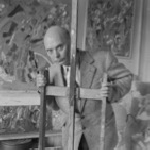
André Lanskoy was a painter born in Moscow, Russia, in 1903, who was mainly active during the 1960s. Renowned for his non-figurative paintings, he was closely associated with the New School of Paris, a group of independent 20th-century French artists who popularised abstraction. Self-taught, he took an early interest in art and produced his first works on paper at the age of sixteen. In the early 1920s, he fled with his family to Kyiv, where he joined Alexandra Exter’s studio. Lanskoy moved to Paris in 1921, where he frequented the circle of the Russian artist Sergei Soudeikine, and exhibited in a group show for the first time at the Galerie La Licorne, followed by the Salon d’Automne in 1924. He held his first solo exhibition in 1925. Whilst the artist initially focused on figurative art, he gradually turned towards abstraction in the late 1930s, spurred on by a movement led by Eastern European artists such as Wassily Kandinsky and František Kupka. His works thus serve to convey his fascination with colour and become a medium for expressing his inner world, shaped by inspirations and influences drawn from his Slavic heritage and his experiences in Paris. His paintings thus evoke atmospheres saturated with intense layers of colour and bold geometric forms, rendered with textured brushstrokes. For the artist, abstraction emerged as a means of transcending the conventions of representation and moving beyond figurative art. Lanskoy exhibited regularly alongside Russian, European and Parisian colleagues until his death in his studio in 1976. His work is held primarily at the Centre Pompidou, the Musée d’Art Moderne in Paris, and the MoMA in New York.
Artist's webSite
André Lanskoy was a painter born in Moscow, Russia, in 1903, who was mainly active during the 1960s. Renowned for his non-figurative paintings, he was closely associated with the New School of Paris, a group of independent 20th-century French artists who popularised abstraction. Self-taught, he took an early interest in art and produced his first works on paper at the age of sixteen. In the early 1920s, he fled with his family to Kyiv, where he joined Alexandra Exter’s studio. Lanskoy moved to Paris in 1921, where he frequented the circle of the Russian artist Sergei Soudeikine, and exhibited in a group show for the first time at the Galerie La Licorne, followed by the Salon d’Automne in 1924. He held his first solo exhibition in 1925. Whilst the artist initially focused on figurative art, he gradually turned towards abstraction in the late 1930s, spurred on by a movement led by Eastern European artists such as Wassily Kandinsky and František Kupka. His works thus serve to convey his fascination with colour and become a medium for expressing his inner world, shaped by inspirations and influences drawn from his Slavic heritage and his experiences in Paris. His paintings thus evoke atmospheres saturated with intense layers of colour and bold geometric forms, rendered with textured brushstrokes. For the artist, abstraction emerged as a means of transcending the conventions of representation and moving beyond figurative art. Lanskoy exhibited regularly alongside Russian, European and Parisian colleagues until his death in his studio in 1976. His work is held primarily at the Centre Pompidou, the Musée d’Art Moderne in Paris, and the MoMA in New York.