André Cervera. Carambolages

The exhibition
André Cervera’s work rejects any notion of compartmentalization or rigidity, embracing instead a constant dynamic of projection, collision, and hybridization. Born in Sète in 1962 and inspired by the punk movement, Pasolini’s films, and the work of Yves Klein, the painter pays a steadfast tribute to his life, his heritage, his travels, and his convictions. Most of the forty paintings brought together at the Paul Valéry Museum in Sète were created over the past two years and bear witness to the vitality and maturity of this traveling painter’s work.
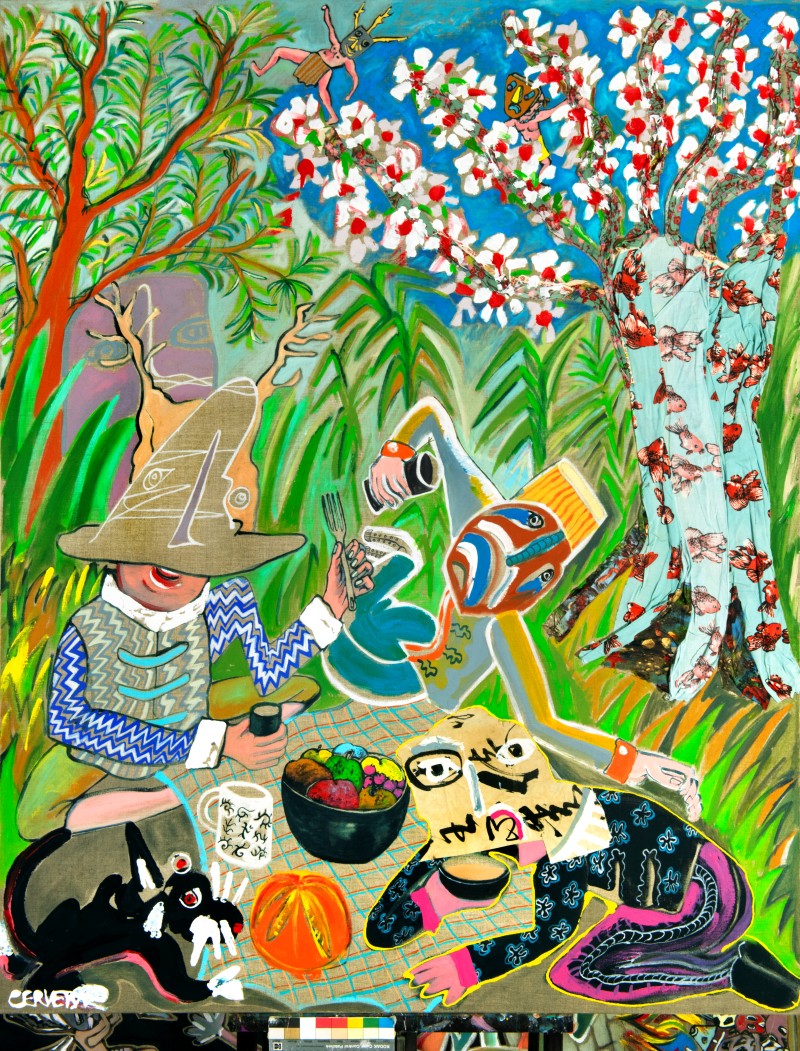
For him, “collision” constitutes a genuine method: Cervera orchestrates the encounter of heterogeneous artistic and cultural references to produce layered images, fix recomposed memories, and stabilize the emotional traces of his past. Much like a cinematic montage, the pictorial surface fragments and reassembles itself, incorporating acrylic, fabric, spray paint, monstrous figures, and popular iconography.
“Les Fictions de Sète” opens the exhibition. Far from a simple autobiographical narrative or placid nostalgia, her childhood in the port town of Sète is depicted as a period of ambivalence: familiar motifs such as streets and games are superimposed upon unsettling forms, such as the repulsive-looking cranes in Les Monstres attaquent la ville (2024).
In “Territoires de l’imaginaire,” Cervera draws inspiration from his extensive travels. From China to India, via Senegal and Morocco, the painter asserts a break with Western culture and the “creolization” of his influences. The artist thus explores the permeability between the visible and the invisible, the symbolism of colors, and takes an interest in shamanic rituals and objects imbued with sacredness. Masks, textile fragments, and everyday objects come together in dense compositions where the stories and materials collected shape new realities.
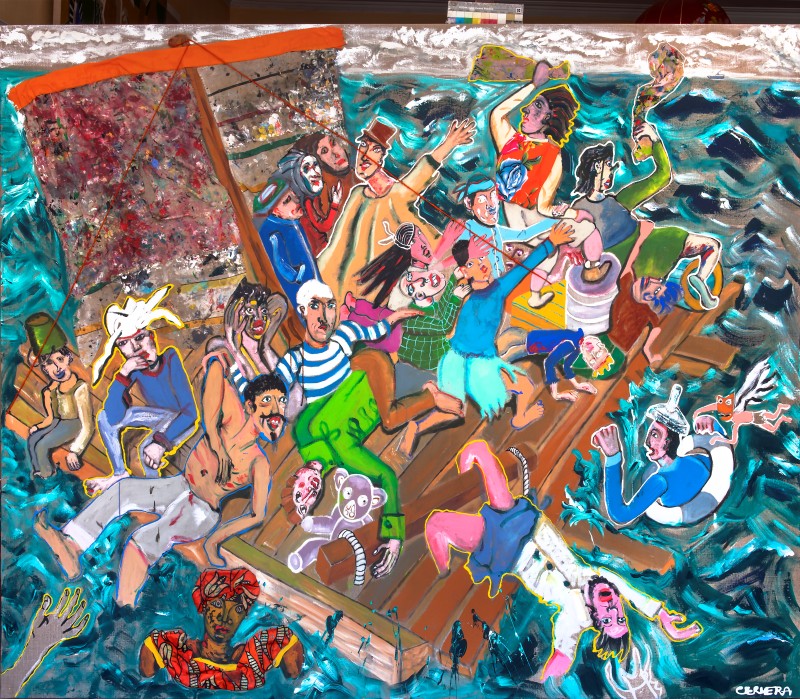
By invoking figures such as Francisco de Goya or James Ensor, Cervera does not quote; he appropriates. Deeply existential, the themes addressed in his “History Paintings” resonate with contemporary concerns. In La Grande traversée (2022), he revisits the shipwreck of the frigate Méduse depicted by Géricault to draw attention to the tragedy of migrants shipwrecked in the Mediterranean.
Twenty-one years after his first exhibition at the Paul Valéry Museum, “André Cervera. Carambolages” invites visitors to navigate between reality and the imagination, exploring the power of memories and the almost ritualistic nature of the artist’s painting. Curated by Camille Bertrand-Hardy and Stéphane Tarroux, the exhibition invites visitors to immerse themselves in the colliding aesthetics of an artist who rejects academic conventions to champion the perpetual hybridization of his multiple references.
Line Puech
For him, “collision” constitutes a genuine method: Cervera orchestrates the encounter of heterogeneous artistic and cultural references to produce layered images, fix recomposed memories, and stabilize the emotional traces of his past. Much like a cinematic montage, the pictorial surface fragments and reassembles itself, incorporating acrylic, fabric, spray paint, monstrous figures, and popular iconography.
“Les Fictions de Sète” opens the exhibition. Far from a simple autobiographical narrative or placid nostalgia, her childhood in the port town of Sète is depicted as a period of ambivalence: familiar motifs such as streets and games are superimposed upon unsettling forms, such as the repulsive-looking cranes in Les Monstres attaquent la ville (2024).
In “Territoires de l’imaginaire,” Cervera draws inspiration from his extensive travels. From China to India, via Senegal and Morocco, the painter asserts a break with Western culture and the “creolization” of his influences. The artist thus explores the permeability between the visible and the invisible, the symbolism of colors, and takes an interest in shamanic rituals and objects imbued with sacredness. Masks, textile fragments, and everyday objects come together in dense compositions where the stories and materials collected shape new realities.
By invoking figures such as Francisco de Goya or James Ensor, Cervera does not quote; he appropriates. Deeply existential, the themes addressed in his “History Paintings” resonate with contemporary concerns. In La Grande traversée (2022), he revisits the shipwreck of the frigate Méduse depicted by Géricault to draw attention to the tragedy of migrants shipwrecked in the Mediterranean.
Twenty-one years after his first exhibition at the Paul Valéry Museum, “André Cervera. Carambolages” invites visitors to navigate between reality and the imagination, exploring the power of memories and the almost ritualistic nature of the artist’s painting. Curated by Camille Bertrand-Hardy and Stéphane Tarroux, the exhibition invites visitors to immerse themselves in the colliding aesthetics of an artist who rejects academic conventions to champion the perpetual hybridization of his multiple references.
Line Puech
When
29/03/2026 - 07/06/2026