Sophie Taeuber-Arp. La règle des courbes
The exhibition
Long overlooked in the historiography of modern art, overshadowed by her husband Jean Arp, Sophie Taeuber-Arp has, over the past twenty years, been the subject of a careful re-examination of her work. This re-evaluation highlights a body of work that is highly consistent in form, developed through a variety of media, and which fits into the history of abstraction and non-figurative art. This reconsideration highlights a body of work of great formal coherence, developed through a variety of media and which forms part of the history of abstraction and the European avant-garde.
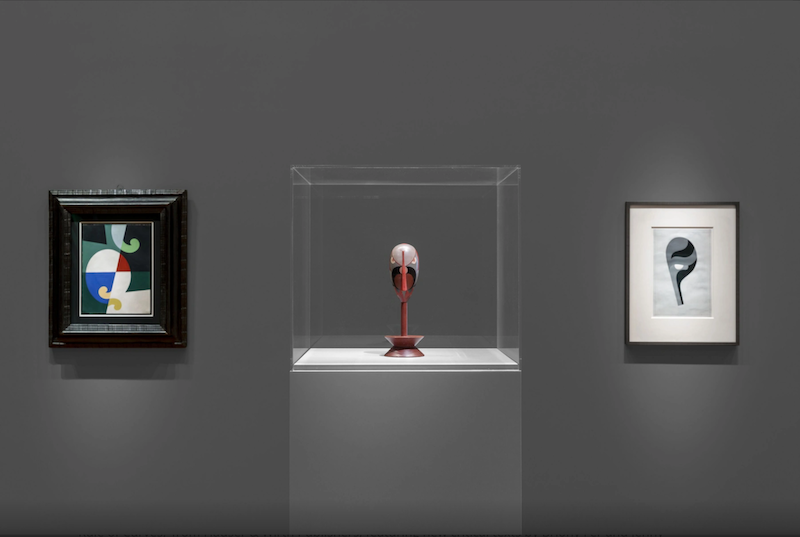
The museum exhibition “The Rule of Curves,” presented at the Hauser & Wirth gallery, offers a journey through Sophie Taeuber-Arp's work, using a central formal element as its guiding thread: the curve. Far from being a simple decorative motif, it appears as a true tool for thought, allowing the artist to shift the established frameworks of the modernist grid and test its limits.
From her early Dadaist experiments in Zurich, Sophie Taeuber-Arp developed a method based on the idea of “exercise", inherited from her training in applied arts. The gouaches, drawings, and turned objects from the period 1918-1920, notably the series of “Heads,” bear witness to this experimental approach.
Developing a play between color and form, she shaped a personal abstract language that would later establish her as one of the pioneers of constructivist art. The curve serves to simulate volume, disrupt the regularity of the grid, and create tension between flat surface and three-dimensional space. Rather than contrasting straight lines with curved lines, the artist explores their interaction, giving rise to compositions that are both unstable and carefully structured.
In the 1930s, this research continued and intensified. The forms became more organic, as evidenced by the “Coquille” series (1936-1938), where the undulating lines evoke natural structures without ever directly imitating them. These compositions, whether drawings or wooden reliefs, are nevertheless created using tracing instruments, parrots, flexible rulers, and templates, which introduce a central paradox into the work: the more free and alive the forms appear, the more their elaboration relies on technical tools. The curve thus becomes the site of a constant dialogue between gesture, instrument, and standardization.
Finally, the series “Échelonnement” (1934-1939) occupies a pivotal place in the exhibition. Through the stacking and repetition of curved and straight forms, Taeuber-Arp questions the notion of measurement, scale, and rhythm, introducing a temporal dimension within the composition itself. The white shapes, which appear to be cut out of the colored background, oscillate between positive and negative, between appearance and withdrawal.
“La règle des courbes” reveals a work of daring creativity, nourished by the applied arts and attentive to tools, gestures, and uses. The exhibition allows us to gauge its scope, despite a trajectory that was prematurely interrupted in 1943, and to grasp the way in which Sophie Taeuber-Arp developed, in a relatively short period of time, a formal logic that defies linear trajectories and classifications.
Alice Miquel
The museum exhibition “The Rule of Curves,” presented at the Hauser & Wirth gallery, offers a journey through Sophie Taeuber-Arp's work, using a central formal element as its guiding thread: the curve. Far from being a simple decorative motif, it appears as a true tool for thought, allowing the artist to shift the established frameworks of the modernist grid and test its limits.
From her early Dadaist experiments in Zurich, Sophie Taeuber-Arp developed a method based on the idea of “exercise", inherited from her training in applied arts. The gouaches, drawings, and turned objects from the period 1918-1920, notably the series of “Heads,” bear witness to this experimental approach.
Developing a play between color and form, she shaped a personal abstract language that would later establish her as one of the pioneers of constructivist art. The curve serves to simulate volume, disrupt the regularity of the grid, and create tension between flat surface and three-dimensional space. Rather than contrasting straight lines with curved lines, the artist explores their interaction, giving rise to compositions that are both unstable and carefully structured.
In the 1930s, this research continued and intensified. The forms became more organic, as evidenced by the “Coquille” series (1936-1938), where the undulating lines evoke natural structures without ever directly imitating them. These compositions, whether drawings or wooden reliefs, are nevertheless created using tracing instruments, parrots, flexible rulers, and templates, which introduce a central paradox into the work: the more free and alive the forms appear, the more their elaboration relies on technical tools. The curve thus becomes the site of a constant dialogue between gesture, instrument, and standardization.
Finally, the series “Échelonnement” (1934-1939) occupies a pivotal place in the exhibition. Through the stacking and repetition of curved and straight forms, Taeuber-Arp questions the notion of measurement, scale, and rhythm, introducing a temporal dimension within the composition itself. The white shapes, which appear to be cut out of the colored background, oscillate between positive and negative, between appearance and withdrawal.
“La règle des courbes” reveals a work of daring creativity, nourished by the applied arts and attentive to tools, gestures, and uses. The exhibition allows us to gauge its scope, despite a trajectory that was prematurely interrupted in 1943, and to grasp the way in which Sophie Taeuber-Arp developed, in a relatively short period of time, a formal logic that defies linear trajectories and classifications.
Alice Miquel
When
17/01/2026 - 07/03/2026