Maria Papa ROSTKOWSKA — Wifredo Lam Imaginaires croisés Albisola et au-delà
The exhibition
Presented at the Galerie Diane de Polignac, the exhibition ‘Imaginaires croisés, Albisola et au-delà’ (Crossed Imaginaries, Albisola and Beyond), curated by Lydia Harambourg, draws parallels between Maria Papa Rostkowska and Wilfredo Lam. Albisola, a hub for artistic experimentation in the post-war period, provides the backdrop. Lam's deliberately limited presence, with two ceramic works, introduces a subtle tension into the exhibition without structuring its overall economy, allowing Maria Papa's sculptures to occupy most of the space.
Spread across three rooms, the exhibition is based on a very sober display that emphasises the legibility of the volumes and the circulation around the works. The marbles are presented on pedestals also carved by the artist, designed as extensions of the sculpted volume. Some pieces, deliberately adjustable, thwart any single frontal view and engage the eye in a successive apprehension of forms. This arrangement establishes a slow temporality, attentive to surface variations and the viewer's movements.
Born in Poland and marked by the occupation of Warsaw, exile and early losses, Maria Papa Rostkowska belongs to a generation for which sculpture is moving away from monumental affirmation towards a more internalised approach. Settling in Albisola in the late 1950s, she developed a practice focused on materials and gestures, before marble became her preferred material in the 1970s. Refusing to use models, the artist worked directly on the stone, entering into an irreversible relationship with the material, where each formal decision was permanent. ‘Marble dazzled me... I perceived its immortality, like a living sea that had frozen,’ she wrote.
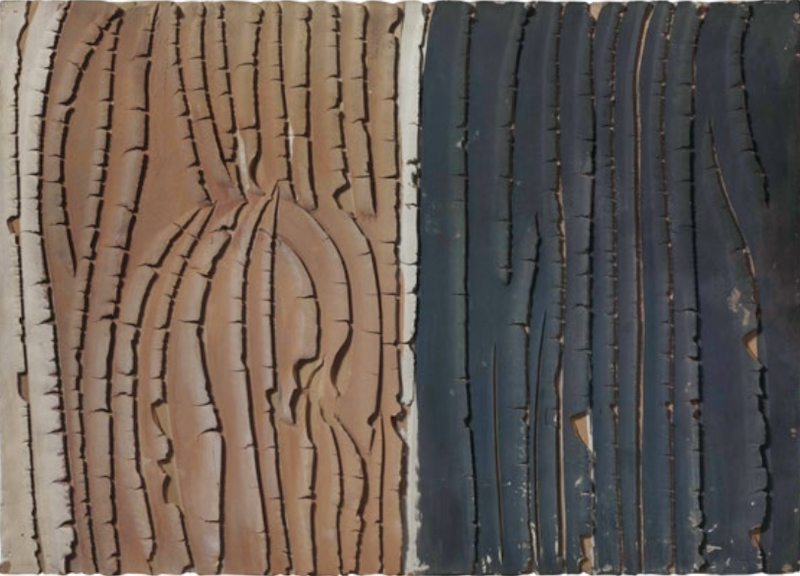
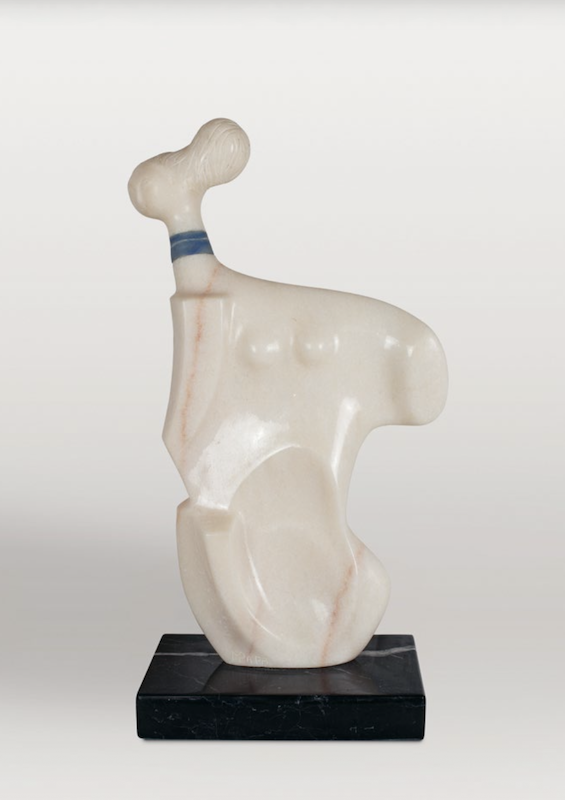
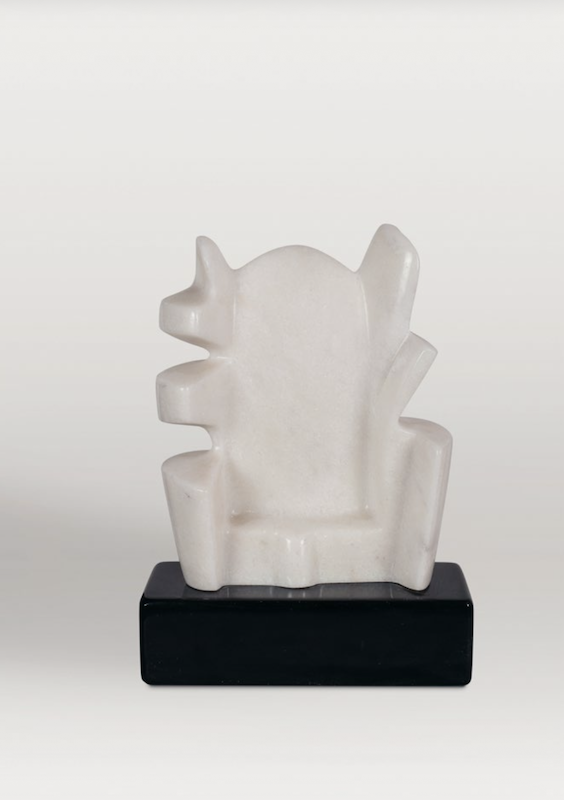
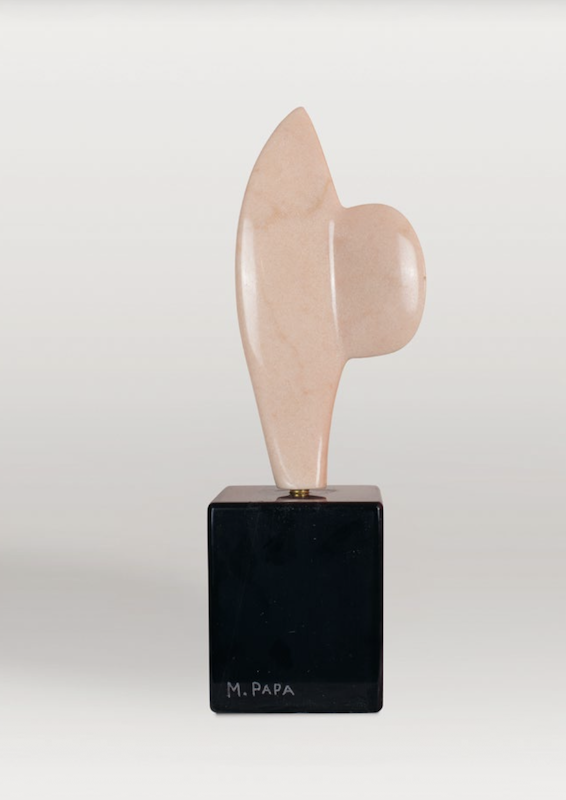
This radical approach gave rise to a body of work characterised by great plastic restraint. Rounded volumes, subtle balances between solids and voids, and forms oscillating between abstraction and suggested figuration compose a refined sculptural vocabulary. The titles, "L’Arbre de vie", "La Maison de rêve", "L’Oiseau du bonheur", "Ganesh", guide the viewer's interpretation without closing it off, leaving the viewer an active role in the interpretation. The bas-relief terracotta works extend this exploration: the forms emerge from the surface without becoming fixed, following a logic of thrust and withdrawal that favours soft lines and restrained movement, far removed from a more undivided and deliberately sharp modernity. While the connection with Wilfredo Lam remains discreet, it nevertheless recalls the role of Albisola as a place where forms and imaginations circulate.
The exhibition thus finds its accuracy in an economy of means, revealing a body of work that favours formal concentration and continuity of gesture over any spectacle.
Although the connection with Wilfredo Lam remains subtle, it nevertheless recalls Albisola's role as a place where forms and imaginations circulate.
The exhibition thus finds its accuracy in an economy of means, revealing a body of work that favours formal concentration and continuity of gesture over spectacle.
Marie Nallet
Spread across three rooms, the exhibition is based on a very sober display that emphasises the legibility of the volumes and the circulation around the works. The marbles are presented on pedestals also carved by the artist, designed as extensions of the sculpted volume. Some pieces, deliberately adjustable, thwart any single frontal view and engage the eye in a successive apprehension of forms. This arrangement establishes a slow temporality, attentive to surface variations and the viewer's movements.
Born in Poland and marked by the occupation of Warsaw, exile and early losses, Maria Papa Rostkowska belongs to a generation for which sculpture is moving away from monumental affirmation towards a more internalised approach. Settling in Albisola in the late 1950s, she developed a practice focused on materials and gestures, before marble became her preferred material in the 1970s. Refusing to use models, the artist worked directly on the stone, entering into an irreversible relationship with the material, where each formal decision was permanent. ‘Marble dazzled me... I perceived its immortality, like a living sea that had frozen,’ she wrote.
This radical approach gave rise to a body of work characterised by great plastic restraint. Rounded volumes, subtle balances between solids and voids, and forms oscillating between abstraction and suggested figuration compose a refined sculptural vocabulary. The titles, "L’Arbre de vie", "La Maison de rêve", "L’Oiseau du bonheur", "Ganesh", guide the viewer's interpretation without closing it off, leaving the viewer an active role in the interpretation. The bas-relief terracotta works extend this exploration: the forms emerge from the surface without becoming fixed, following a logic of thrust and withdrawal that favours soft lines and restrained movement, far removed from a more undivided and deliberately sharp modernity. While the connection with Wilfredo Lam remains discreet, it nevertheless recalls the role of Albisola as a place where forms and imaginations circulate.
The exhibition thus finds its accuracy in an economy of means, revealing a body of work that favours formal concentration and continuity of gesture over any spectacle.
Although the connection with Wilfredo Lam remains subtle, it nevertheless recalls Albisola's role as a place where forms and imaginations circulate.
The exhibition thus finds its accuracy in an economy of means, revealing a body of work that favours formal concentration and continuity of gesture over spectacle.
Marie Nallet
When
15/01/2026 - 07/02/2026