Vera Pagava
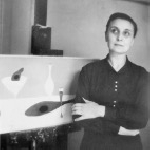
1907 (Tbilissi) / 1988 (Montrouge)
Artist's gallery
Vera Pagava is a Georgian painter and draughtswoman, associated with the Second School of Paris. Born in Tbilisi, she moved to France at the age of sixteen, where she began her artistic training whilst engaging with the Georgian community in exile in Paris. She studied, in particular, at the École nationale des arts décoratifs, and subsequently at the Académie Ranson. Her practice began as figurative before evolving into a particularly accomplished form of abstraction. She regards this new approach to painting as both a liberation and a necessity, defining it as an “absolute quest for the pictorial transposition of light”. Her canvases explore a muted, spectral world, where blocks of colour and simplified geometric forms create a sense of tension. The artist strives for a pure composition and expresses a singular, unadorned relationship with space, enhanced by a sombre, muted palette.
In 1958, she came to prominence in particular through the monumental painting she created for the Holy See’s pavilion at the Brussels World’s Fair. She remained particularly active well into the 1980s, undertaking numerous commissions and high-profile collaborations. Her paintings were the subject of a major retrospective in 1982. The artist is currently enjoying a major resurgence in popularity, as evidenced by several exhibitions at the National Gallery of Georgia in 2012, the Pushkin Museum in Moscow and the Centre Pompidou in 2021, the Museum of Modern Art in Paris in 2022, and the Guggenheim Bilbao in the same year. His work thus continues to make its mark across Europe.
Artist's gallery
Vera Pagava is a Georgian painter and draughtswoman, associated with the Second School of Paris. Born in Tbilisi, she moved to France at the age of sixteen, where she began her artistic training whilst engaging with the Georgian community in exile in Paris. She studied, in particular, at the École nationale des arts décoratifs, and subsequently at the Académie Ranson. Her practice began as figurative before evolving into a particularly accomplished form of abstraction. She regards this new approach to painting as both a liberation and a necessity, defining it as an “absolute quest for the pictorial transposition of light”. Her canvases explore a muted, spectral world, where blocks of colour and simplified geometric forms create a sense of tension. The artist strives for a pure composition and expresses a singular, unadorned relationship with space, enhanced by a sombre, muted palette.
In 1958, she came to prominence in particular through the monumental painting she created for the Holy See’s pavilion at the Brussels World’s Fair. She remained particularly active well into the 1980s, undertaking numerous commissions and high-profile collaborations. Her paintings were the subject of a major retrospective in 1982. The artist is currently enjoying a major resurgence in popularity, as evidenced by several exhibitions at the National Gallery of Georgia in 2012, the Pushkin Museum in Moscow and the Centre Pompidou in 2021, the Museum of Modern Art in Paris in 2022, and the Guggenheim Bilbao in the same year. His work thus continues to make its mark across Europe.